Showing posts with label Government as a Platform. Show all posts

Saturday, November 20, 2010

Reboot

The current technological landscape is obsessed with data. Open data, data API's, walled gardens, data silos, data stores, the semantic web - the list is endless. Gov 2.0 is all about getting access to government data: the US has data.gov, the UK assigned Tim Berners-Lee to kick off data.gov.uk, and similar efforts are underway elsewhere. Data, data, data. Indeed, Tim O'Reilly says the internet OS is a data OS. In reality, all operating systems are data operating systems, and the internet OS is no different.

Data or Process?
So what's wrong? Well, we seem to be confused: we seem to be separating data from the processes which operate on that data. Open data and open software are separate topics right now. Inert data as the next internet frontier is being heralded as a profound observation, and that's a mistake. Sometimes boiling things down so that they're simple and concise shows a superior grasp of both the subject matter and the communication medium. Sometimes it just means you've missed something important.

The processes which operate on data are data. If you look at the bits and bytes of your hard drive, it is impossible to distinguish between Photoshop the application and the Photoshop files. They're just data. Look at it another way - when a developer saves a code file, the code is data to the development environment. And the code for the development environment is data to whatever was used to develop it. Even more philosophically - which came first - data or process? A simple demonstration of how much easier this makes things: transparency in government - we don't just want census 'data' to be made available, we also want the process of census taking to be open. In fact, the latter has significantly greater implications for our ability to participate in the government machine.

From this perspective, the internet OS is just like any other - a magical structure that bootstraps itself from a singularity and delivers a universe of complexity and beauty. How we managed to use the term operating system and forget process is a mystery. We can observe the damage that is caused quite plainly - what would an OS that didn't appreciate process look like? All the applications would be completely different, they would each require separate logins, have different controls, non-standard interfaces, install differently, fail differently, report differently, vary significantly in quality, fail to integrate in most cases, or in ad-hoc manner in a few - we'd have silo's and lack of transparency, lack of trust, poor resource usage, lock-in... what a nightmare! Oh wait... that's the internet - an OS that's way too focussed on a concept of inert data. We are starting to see the open data discussion extend to things like - 'who should maintain this data?', 'how should this data be analysed?', 'what means were used to collect this data?' - Oops! Did we forget something? Time to apply our understanding of how an OS really works. Time to reboot with a new kernel version that better understands process.

Friday, November 19, 2010

Ubiquity

A recent article in the Wall Street Journal highlights the emergence of new internet monopolies around points of control. Strangely, they aren't emerging due to clever positioning, supplier agreements, partnerships or high market entry costs. They are emerging because monopoly is the most effective configuration for delivering user benefit.  A connective system delivers the greatest convenience and perceived benefit when it is universal. For example, the bigger and more connected the social graph, the more powerful it is. Ubiquity is inevitable. The internet operating system is emerging, not as loosely connected competing components, but as ubiquitous infrastructure.

Our power infrastructure is ubiquitous, our roads, the internet itself - all of them connective systems. There is no competition for the internet - what use would an alternative be? Its unconnected value is too low - no matter how brilliant its engineering. If we look at roads: sure, private companies build roads - but they don’t get to choose what side we drive on, what a stop sign looks like, or what the national speed limit is. The universal nature of the road infrastructure is what drives the incredible competition in the auto industry, and the user benefit is enormous. When such platforms are freely available, we reap the greatest benefit from competition. Ubiquitous infrastructure shouldn’t be what we compete for, but what we compete on. Of course, this doesn't stop companies trying to own the platform, and many succeed in doing so for long periods of time. However, without exception, the greater benefit is derived when the platform is the arena for competition, not the subject of it.

There’s an interesting conclusion to be drawn here - Facebook cannot own the social graph any more than Ford can own the road infrastructure. If Ford could control Toyota's access to the road infrastructure, you would expect a situation similar to that between Google and Facebook. Competition would be severely restricted. Facebook has 'won', but only something that will slip inevitably from its grasp. The social graph must be a platform for competition, not the target of it. Anti-competition litigation seems inevitable.

Facebook losing control of the social graph also highlights the ethereal and necessary companion of ubiquitous infrastructure - benevolent governance. Who should administer the social graph for the good of all? It's not something you're likely to get from a corporate monopoly, but something that is going to become increasingly necessary. Terry Jones observes the following when responding to Tim O’Reilly's question ‘Where is the Web 2.0 address book?’:
Relief does not lie in the direction of more applications behind more API’s. It lies instead in allowing related data to co-exist in the same place.’
A call for ubiquitous infrastructure, and the question of governance arises in the article's first comment -
‘But who owns and runs the central datastore? Why should they be trusted? Who foots the bill and how?’
A common shared database would make our lives easier - one might argue, in fact, that the social graph is simply a subset of this.

What we are seeing here is the emergence of new components that belong in the fabric of the web - things that should join HTTP and DNS and perhaps learn lessons from their governance. The social graph and the common database are just the beginning - we are witnessing the formation of the internet operating system - not as a loosely connected set of competing technologies (for that is just the chaotic state prior to equilibrium), but as an emergent, ubiquitous internet infrastructure upon which real competition can thrive. This is not a process that ends - new candidates for inclusion will appear continuously, and it may be the case that the natural emergence of monopolies highlights these candidates for us. The sooner this infrastructure is delivered as an open and level playing field, the sooner we will reap the true rewards of competition in this new age of connectivity.

Sunday, January 17, 2010

Who are you today?

Our current model of identity online is a poor representation of how we manage identity in the real world. As mass participation becomes ubiquitous, and the web becomes one of our primary social and political environments, we need to do better. Multiple identities, pseudonymity, anonymity and credibility are necessary aspects - a fundamental part of how we should be managing identity on the web. Most importantly, public participation in government needs a unified mechanism for managing these things. I'll propose the basis for a mechanism that supports this - one that reconciles the desire for multiple identities with the hassle of multiple logins.

Before starting, it's necessary to highlight a series of blogs about online identity by Andy Oram. He does an excellent job of assessing the landscape - the coverage is extensive and well researched. One key observation he makes is that our online identity is becoming more unified rather than fragmented. This is true, but it is happening because we are engineering identity management to achieve this - not because this unification is a natural expression of our human nature.
    Why is maintaining separate identities worthwhile?

    Andy Oram pointed to some research that highlights a main argument for maintaining multiple identities -
    [Sherry Turkle] claims that we do maintain multiple online identities, and that this is no simple game but reflects a growing tendency for us to have multiple selves. The fragmentary and divided presentation of self online reflects the truth about ourselves, more than we usually acknowledge.

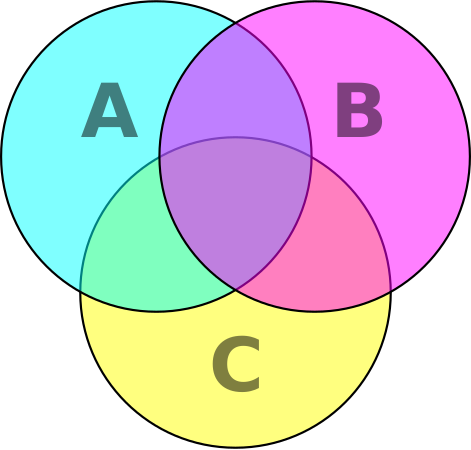
    It's not a strange multiple personality disorder that we're all afflicted with - it's simple human nature. We can think of our society as a complex multi-dimensional venn diagram, where each person's perception of their identity is represented by a single circular region, and intersections between these regions represent groups.  We see this all the time in our personal relationships - there are obvious differences between how our partner, family, friends and colleagues understand us, and what information we are prepared to offer them. We maintain all of these relationships - we keep information from some people while providing it to others, and people sometimes make stuff up. It's not some nefarious deceit - it's just a fundamental part of the way humans manage relationships.

    We see regular evidence of this human behaviour online. We attempt to keep professional and social associations separate on Linked-in and Facebook. We experience discomfort when 'friended' on Facebook by people we don't consider friends. Obviously the boundaries vary greatly for each person and within each group, but that's part of the point - everybody is different, everybody creates boundaries where they are comfortable, and not everybody is a friend. The push to make us all singularly open creates weird fantasy lands - just what you would expect in the real world if we were only able to expose a single identity - the minimum intersection that is comfortable in every context.

    An unfortunate aspect of this is that our uniqueness, our creativity, our gravitas even, is often best represented by the parts of us that intersect the least. This is regularly the best expression of who we really are, what drives us, and what makes us unique individuals. We have many real world identities - subsets, intersections and mutual exclusions - all of them constantly moving. It seems utterly counter-intuitive to me that we should be engineering our online world to bring all the regional intersections of our social venn diagram into alignment. Unless we are trying to model something different to real-world identity, then we're doing it wrong.

    Tim O'Reilly noted that 'It's not a matter of perfect intelligence and perfect stupidity, its a matter of a mixture of intelligence and stupidity, of brilliance and idiocy all in the same brain, of failures of will, failures of virtue, failures of goodness, at the same time as enormous heroism, enormous accomplishment - all these things are going to be true of internet applications, just as it is true of individuals'.  We need to embrace our humanity, and recognise that the quest for our one true, homogenous and palatable internet identity is just an insidious endeavour in global groupthink.

    Multiple identities online give us new opportunities for self expression as well - providing the capability to publicly explore elements of our psyche that we would otherwise keep private. Some of that will be roughly hewn rubbish, it's true, but the key here is that the internet provides new opportunities to be comfortable with being wrong. If we are anonymous, we need not fear rejection. This is important, because the idea of 'fail fast' is one that we know to reap rewards. Allowing multiple identities gives us new opportunities to fail fast as individuals, and, on rare occasions, to succeed fast. Either way it's a win-win situation. It's not just the identity owner who benefits - if we enable more fail-fast behaviour, for individuals and groups, then society as a whole benefits enormously.

    How can we engineer support for multiple identities?

    Whether or not you agree with the argument for multiple identities, a mechanism for achieving it is reasonably obvious. If we see the internet operating system emerging, then we should need to log in once with an identity provider, and have the opportunity to switch profiles at will. Each application in the operating system sees a profile as an identity, and only the identity provider maintains the information that associates profiles. It's up to me whether I want one or many profiles. It's my responsibility to take as little or as much care as I like to keep these worlds logically separate from each other. I get to define how much information about my true identity is revealed in a particular profile. If I only want one profile, then usage would be identical to our current experience. It's fairly simple, and it's a better match for the reality of how we manage identity in the real world.

    It's understandable that we don't have this today1 - but we shouldn't kid ourselves that what we do have is a good representation of how we manage identity in the real world. Sometimes we seem to be working on the assumption that human nature should be changed rather than modelled [Mark Zuckerberg][Eric Schmidt]. Looking at the Apple Human Interface Guidelines for some perspective on this is quite helpful -
    To help you discover the mental models people associate with your product’s tasks, look at how they perform similar tasks without a computer... Design your product to reflect these things, but don’t insist on replicating each step a user might take when performing the task without a computer. Take advantage of the inherent strengths of the computing environment to make the whole process easier or more streamlined.
    Obvious stuff, and it not only highlights that we should be modelling the way people do things in the real world, but that we should be seeking improved facilitation of this behaviour.

    Additional considerations with this approach

    It might be argued that people maintaining multiple identities is a hassle for the authorities. However like most things, regulation and control is a better solution for something that people will undertake regardless of the authorities' position. A key element of the above solution is that an identity provider maintains the relationship between profiles, and can correlate this to a single login. A profile can be provided to an application with data that only the identity provider can use to perform this correlation. It's easier to regulate and control. I'm not suggesting people would cease to create multiple logins, but we would observe some separation between those who manage multiple identities for reasons of self expression, and those who do so for nefarious purposes. Of course there are many legitimate reasons why someone might not want any linking information to be stored, and I'll explore that scenario below when looking at 'true anonymity'.

    The risk of unauthorised access at the identity provider is real, as is hacker activity. These represent the greatest risk to identity management in general, but especially maintenance of separate identities. It seems clear to me, however, that as identity provision becomes standardised, and its importance better understood, the need for security and enforcement against such breaches will become more obvious and more regulated. The role of identity provider will increasingly become one which carries significant responsibility and users will choose an identity provider on the basis of how they perceive the security they offer. As we enter the world of public participation in government, many aspects of identity management will become increasingly necessary - the need for regulation, trust, verifiability and credibility will all see an increase in importance.

    Credibility

    Credibility is something that we know is necessary for online activities that require trust. No one likes a zero star seller. With the identity management solution outlined above, we get new opportunities for managing credibility - especially if this is something maintained by the identity provider. For example, e-bay could specify that their reputation is transferable between user identities - so that no matter which profile we enter e-bay with, we retain a common reputation score. Conversely, a forum might specify that reputation is not transferrable. This leads to yet another interesting possibility - the capacity to merge profiles. If you have been posting on a forum with multiple profiles, you might choose to combine them, and with such a merger deliver increased (or decreased) reputation to the new identity.

    One of the arguments against multiple identities is that it generates a lot of noise - people being antagonistic, offensive or just spouting rubbish with no requirement to own up to these contributions. Using a credibility mechanism provides an excellent tool for managing this problem. A profile with low credibility (such as one that is newly created, or often marked down) can be easily distinguished from one with high credibility. It would generally be in the user's interest to improve the credibility of the profiles that they use. Credibility metrics are a critical example of how we can achieve additional benefits in online identity management.

    Verifiability is a part of credibility, but it has some interesting additional aspects. An identity provider could offer the means for you to verify that you are you. If you provided your passport or driver's licence, then the identity provider could indicate this increased confidence in each of your profiles by increasing your credibility. In something like participation in government - the fact that you have this kind of credibility could be a requirement for participation in some forums. Something similar could be achieved for qualifications. This mechanism would also provide significant protection against online identity theft. I'm not proposing that this should be a requirement for having an online identity, but would represent a legitimate option for improving credibility.

    Plenty of other credibility management opportunities exist, particularly around endorsement by others - but the basic argument is that delivery of a mechanism for managing credibility - one that can span the entire user or individual profiles and apply both in individual applications and universally - is a basic and necessary part of participation on the web.

    What about Gov 2.0?

    Gadi Ben-Yahuda provided some good analysis of the role of anonymity in Gov 2.0, observing that there are pro's and con's. He concluded that we do need to reveal our true identity to contribute to online government, and constructed a useful scale of escalating disclosure on the basis that the more influence you have, the less private you should be. He concluded that participation in Gov 2.0 required scrutiny a little greater than we would expect when speaking at a town-hall. However, it's a one-size-fits-all observation - Gov 2.0 should enable us to participate at all the levels he identified and more in between. With the ability to maintain multiple online identities, we can achieve this relatively easily, providing the user with the means to reveal only what is required by the particular forum. This is a great application of the human interface guidelines - we can deliver a better outcome by taking advantage of the strengths of the computer environment.

    His main argument in support of anonymity is that it allows the speaker to be completely truthful - they don't need to fear personal repercussions for saying what they really think. It's important to observe that this is the primary reason why we vote anonymously. Not only that, but it's considered rude to expect someone to tell you how they voted. It's a critical example of the need for anonymity in real world government processes.

    True Anonymity

    The Electronic Frontier Foundation makes a number of good points on the role of anonymity, especially in relation to government and politics. The statement highlights the fact that we need secure anonymity. They argue that you will only say what you think if you feel confident that your anonymity can be preserved. Clearly if an identity provider maintains the relationship between your profiles, and provides trackable information to an application (even though the application itself cannot use it), then there is no such guarantee.

    For true anonymity to work, the identity provider must deliver an anonymous profile to the application - one that does not contain information to link back to the user id at the identity provider. You might maintain many anonymous profiles, and provide as much or as little information as you liked - your credibility, your country of residence, even your postcode - the key is that the application isn't given the specific identifying information needed to trace back to your account at the identity provider. Obviously if you gave up too much information in your anonymous profile, then deduction might be sufficient to identify you - but that is a risk for the user to manage. Also, there would be no way for credibility to be affected by contributions made anonymously, but providing your base credibility with the anonymous profile might be considered useful in some contexts. It is important to recognise that we can achieve 'true anonymity' while still providing information that is trustable, and might be required in a particular forum.

    Another consideration is that delivering true anonymity would need to be reconciled with the authorities' desire to track internet usage against real identities - a battle which the EFF and governments are fighting on a daily basis. It's not necessary to open this can of worms here - just to observe that there is no technical reason why true anonymity cannot be supported. Even more importantly, if we want to realise all the benefits that Gov 2.0 can offer, then we need to support it.

    Conclusions

    Andrea di Maio said we need to balance the desire of government to get closer to citizens while respecting their desire and right to privacy. It's worth highlighting that the converse is also true - we need to balance the desire of citizens to get closer to government while respecting their desire and right to privacy. Citizens shouldn't be required to reveal more than is necessary - precisely because the most important thing is knowing what people really think. Effectively managing multiple identities and anonymity is a major facilitator in lowering the barriers to participation in government.

    We are correct to strive for a one-to-one relationship between our physical self and our internet login, but mistaken to extend that to the relationship between our login and our online presence. I've offered a rough outline for a solution, and looked at some of the opportunities and risks. It's true that our current software infrastructure would struggle to realise this vision, but it's a simple argument - if people are creating multiple identities online and will continue to do so, and if the benefits are clear, then why aren't we modelling this behaviour properly with online identity? The social web must enable us, not constrain us.


    UPDATE 18/01/10: It seems I missed the Open Identity For Government initiative while researching this post. I'm not sure how I managed that, but there it is. The initiative is high profile, wide ranging, and highly relevant to this discussion. It's based around OpenID & Information Cards, and provides many of the technical elements of my suggested solution - specifically: true anonymity with verifiability, pseudonyms, limiting personal information depending on the forum, centralised management at a trusted identity provider and strong regulation at the identity provider. The system also offers the ability to maintain multiple identities, although aspects such as identity merging & portable credibility do not seem to be supported. The initiative is, however, a great basis on which to build these elements, as it represents an ideal subset of my proposal. From another perspective this post represents an independent thought stream that reached the same conclusions, and provides plenty of meat for going beyond their proposal. In any case, apologies for the research gap - at least I found it before someone pointed it out to me :) I'm really excited by the direction that the Open Identity Initiative is taking. It looks like we're doing it right after all!

    1. There is some recognition of this concept in OpenID, with a 'personas' feature allowing you to maintain different sets of information with a single OpenID. It's heading in the right direction, but it's an optional registration extension, and only implemented by a few identity providers (e.g. myOpenID). It is only utilised when registering with a service provider (application), and certainly not something the service provider needs to be aware of.  The OpenID specification itself has very few references to the concept - simply describing the feature as
    'A subset of the user's identity data. A user can have multiple personas as part of their identity. For example, a user might have a work persona and a home persona.'
    It's ineffective for maintaining multiple identities in the manner I have described for a number of reasons, but primarily because each persona is a subset of the same data set, and secondly because there is no mechanism or requirement for the service provider to recognise separate personas. One reason for this is that it would be considered too big a job to add this support to all of the applications on the internet. However I think if you saw a few major providers - Google, Facebook etc. - doing so, smaller players would begin to support it as well. Another reason might be the added complexity to users - 'I know about username and password - what's this new persona thing'? However it would be simple to hide the persona features using a default persona, and making that the standard behaviour - the usage flow would remain unchanged for those that don't use the feature. A user need not even be aware the feature exists.
    Wednesday, January 6, 2010

    Policy Management is Knowledge Management

    Dennis Howlett recently posted a scathing put-down of Enterprise 2.0 - declaring that Web 2.0 for the enterprise only makes sense in knowledge based businesses, and that even then the use cases are hard to come by. It prompted Dave Briggs to ask the question 'Is government a knowledge business?'.  I'd like to propose two things:  that all business is knowledge business, and that absolutely yes, government is a knowledge business.  I'll back up both, beginning with an analysis of policy making.

    I provided my rough definition of government in a previous post when picking up on Tim O'Reilly's vending machine analogy. The main observation is that government represents the policy management process for our society.  What then is a policy management process?  The UK Government Cabinet Office took a stab at it in their Better Policy Making [pdf] report, and outlined 9 features of modern policy making (summary taken from homepage) -
    • Forward Looking - Defining policy outcomes and taking a long term view
    • Outward Looking - Taking account of the national, European and international situation; learning from the experience of other countries; recognising regional variations.
    • Innovative, Flexible & Creative - Questioning established ways of dealing with things, encouraging new and creative ideas, identifying and managing risk.
    • Evidence Based - Basing policy decisions and advice upon the best available evidence from a wide range of sources; ensuring that evidence is available in an accessible and meaningful form.
    • Inclusive - Consulting those responsible for implementation and those affected by the policy; carrying out an impact assessment
    • Joined Up - Looking beyond institutional boundaries; setting cross-cutting objectives; defining and communicating joint working arrangements across departments; ensuring that implementation is part of the policy process.
    • Review - Systematic evaluation of the effectiveness of policy is built into the policy making process.
    • Evaluation - Existing/established policy is constantly reviewed to ensure it is really dealing with problems it was designed to solve.
    • Learns Lessons - Learning from experience of what works and what does not.
    It is an interesting list, and if we look at some keywords from each definition - defining, learning, experience, questioning, advice, evidence, consulting, communicating, evaluation, review, design - it sounds pretty 'knowledge' oriented.  Interesting too, that even human resources are framed in knowledge management terms.

    I'd like to go a little further. Wikipedia describes policy (selected sentences):
    A policy is typically described as a deliberate plan of action to guide decisions and achieve rational outcome(s). However, the term may also be used to denote what is actually done, even though it is unplanned.
    The term may apply to government, private sector organizations and groups, and individuals. 
    Policies can be understood as political, management, financial, and administrative mechanisms arranged to reach explicit goals.
    It's hard to avoid seeing this as a concise description of what business is up to.  Going further - do we, humans, do anything but policy management? Perhaps a more palatable question is 'Do we, humans, do anything but knowledge management'?

    Wikipedia has this to offer on knowledge management (selected sentences):
    Knowledge management (KM) comprises a range of practices used in an organisation to identify, create, represent, distribute, and enable adoption of insights and experiences. Such insights and experiences comprise knowledge, either embodied in individuals or embedded in organisational processes or practice.
    KM efforts typically focus on organisational objectives such as improved performance, competitive advantage, innovation, the sharing of lessons learned, and continuous improvement of the organisation.
    In terms of the enterprise, early collections of case studies recognized the importance of knowledge management dimensions of strategy, process, and measurement. Key lessons learned included: people, and the cultures that influence their behaviors, are the single most critical resource for successful knowledge creation, dissemination, and application; cognitive, social, and organizational learning processes are essential to the success of a knowledge management strategy; and measurement, benchmarking, and incentives are essential to accelerate the learning process and to drive cultural change. In short, knowledge management programs can yield impressive benefits to individuals and organizations if they are purposeful, concrete, and action-oriented.
    We're talking about the same thing here.  Policy Management is Knowledge Management. This is what humans do, as individuals and as organisations - it's all we do - create and implement policy through a process of knowledge management. This is what government does right now, and it is from this perspective that Gov 2.0 will be realised.

    The UK conservative party recently touched on this:
    There are currently no technological platforms that enable in-depth online collaboration on the scale required by government...
    It is crazy that these things have gone wrong when you've got lots and lots of retired health professionals, retired policemen, people in the teaching profession, who have huge knowledge and expertise and had they been able to contribute better to the policymaking process we could have avoided some of these problems.
    So, is every business a knowledge business? Too right it is - as a collection of humans, there's no alternative. And to answer Dave Brigg's question - 'Is Government a Knowledge Business'? You bet - all our organisations - right down to our solitary selves - are just policy processes in specific contexts. We are - individually and collectively - knowledge management machines.

    When looking at government as a platform, our single, axiomatic goal is to open up, improve and oil the knowledge management process that is government. If we do this, we get a better vending machine.

    Saturday, January 2, 2010

    Political Entropy

    Entropy is a strange word. If we look at some definitions, the strangeness becomes apparent through a list of synonyms: chaos, uncertainty, equilibrium, stasis, homogeneity. I'm going to use it to show that public participation in the policy process is inevitable. Unavoidable. A sure thing.  We need to get ready for it.

    In thermodynamics, where it all started, entropy is a measure of the uniformity of energy distribution within a system - higher entropy means more uniform distribution. John von Neumann is reckoned to have told Claude Shannon to name his measure of uncertainty in information theory 'entropy' because (among other things) 'nobody really knows what entropy is, so in a debate you will always have the advantage'.

    Wikipedia offers:
    'An everyday example of entropy can be seen in mixing salt and pepper in a bag. Separate clusters of salt and pepper will tend to progress to a mixture if the bag is shaken. Furthermore, this process is thermodynamically irreversible. The separation of the mixture into separate salt and pepper clusters via the random process of shaking is statistically improbable and practically impossible because the mixture has higher entropy.'  - Wikipedia
    This highlights another key part to our understanding of entropy - a closed system will increase in entropy both inevitably and irreversibly. We can see this in cosmological entropy, which argues that our universe is a closed system, and will thus reach a state of maximum entropy where all energy is evenly distributed and (consequently) all parts of the universe will be the same temperature.  It's a theory that doesn't bode well for us in the (very) long run.

    For me, when I hear the word entropy, I don't perceive a unit of measure - I perceive the irrevocable march toward homogeneity. Keeping heterogeneous things that are in contact from becoming homogenous takes a lot of effort. We see global systems become more alike as they come into contact, loss of biodiversity, loss of cultural diversity, loss of political diversity, loss of economic diversity, and loss of the protections that come with diversity. There's not much to be done about it either - as we go global, as our culture becomes a single closed system, rising entropy is inevitable. We see our attempts to keep our heterogeneity alive taking a lot of energy, and generally failing.

    In light of this, we might observe three options:
    1. Get some negative entropy - find some new cultures
    2. Start embracing entropy - hooray for homogenisation!
    3. Create closed systems - don't put salt and pepper in the same bag
    Point 1 only delays the inevitable. It is highly interesting that elements of both point 2 and point 3 are generally championed as solutions to the problems we face today. Is retaining some heterogeneity while allowing some homogenisation the right approach? Can it be possible to maintain both heterogenous and homogenous elements in a closed system? What is the right combination and how do we control it? According to the laws of entropy, it would appear that we can neither stop nor reverse homogenisation. Of course seeing our world as a closed system is short sighted: it is part of our solar system, which is itself part of our galaxy, and our universe. We get energy exogenously from the sun, and all life ultimately uses this source of energy to endogenously maintain diversity - to swim against the relentless tide of rising entropy. From this perspective we apparently have great potential to choose between homogeneity and heterogeneity. The trap, however, is that whenever our attention wavers, the tide sweeps us a little further toward homogeneity, and the way back may never appear. We must fight perpetually for heterogeneity if we want it. Once we perceive diversity, it is at permanent risk of fading away.

    The term 'political entropy' is interesting:
    “The entropy measurement gives the average social uncertainty about what will happen for event sets in the social system. An entropy value for a unitary social system is analogous to a temperature reading for thermodynamic system, such as a volume of gas . In a state of temperature equilibrium one temperature measurement describes the whole volume of any part of it. If a social system is in an entropy equilibrium, a single entropy measurement describes the state of the system or any subsystem. For a system in partial equilibrium, the entropy values of its subsystems must be known.“ - Stephen Coleman
    Coleman is saying that when we reach maximum political entropy, we will have maximum uncertainty over what is happening - in a democratic system this might mean many candidates with similar popular support - calling the result is very difficult.  Further research supports this interpretation: Coleman felt that the lowest entropy system was one where the certainty of the political outcome approached 100% - e.g. a one party democracy.  He also understood voting patterns as a means to measure political entropy - at minimum entropy any vote sample will identify the outcome, while at maximum entropy we must sample the entire vote to reach a conclusion.

    One key aspect of the thermodynamic system is the inevitable tendency toward homogeneity, and Coleman identifies this is in his discussion of political entropy - we will head towards political systems with less certain outcomes. Also highlighted is the role of heterogeneity - the presence of subsystems, each of which must also be undergoing changes in entropy, and which influence each other to reach an eventual state of entropy equilibrium.  This subsystem relationship must also be recursive, with subsystems containing subsystems to an undefined degree of complexity.  The conclusion here, then, is that at maximum entropy a democratic political system is homogeneous - every citizen is a candidate with the explicit support of themselves alone.

    Of course, we don't have the mechanics to support such a homogenous system - it is not possible for political entropy to reach that equilibrium.  It doesn't make sense at many levels - what are the means of election? what are the means of governing?  In fact, a maximum entropy democracy sounds a lot like anarchy. That's ok though - it's a theoretical maximum, an ideal - it serves as a bookend in the entropy discussion. We can observe, however, that public participation in policy making provides a pressure to increase political entropy - more people, more involved, more often. And therein lies a small paradox - our quest for transparency, for involvement, to have a say in our own government will actually deliver less certainty.

    Less certainty? We don't want that do we? One might assume such at first glance, but if we look at some recent history of certainty [Iraq War][Copenhagen][Business deals][Credit Crunch][Iran election] we may see that it is in fact our our ignorance and impotence that drives calls for a more participatory and open government.

    So now, with a little imagination, we can begin to see our political and cultural landscape through the lens of thermodynamics - as bubbles of gas inside each other, determined to coalesce into a single bubble of uniform temperature. On this landscape, humanity helps, hinders, increases, reduces and divides these bubbles - often unintentionally, and often without understanding the outcomes and implications.

    When we look at the future of government, something becomes clear in the context of this discussion - it is inevitable that citizen involvement will increase and, barring monumental upheaval, we can't stop it, and we can't go back.  We're going to need better tools to manage our cultural and political entropy - because government as a platform will deliver mechanisms that allow us to move ever closer to the theoretical maximum.

    Sunday, December 27, 2009

    Measuring Opportunity

    In a recent post, I discussed 'compulsory voting' as a powerful tool for measuring opportunity. It is important to note that 'compulsory voting' only mandates that you demonstrate your opportunity to vote, and does not compel you to vote.

    Some theorists suggest that democracy is not something that everyone should participate in :
    "The effective operation of a democratic political system usually requires some measure of apathy and noninvolvement on the part of some individuals and groups." - Samuel P. Huntington
    There is a perception [Noam Chomsky][Andrew Gelman] that Huntington was proposing a ruling elite - a minority rule in which (as Chomsky puts it) '... the peasants cease their clamor'. From such a perspective it is hard to extract the idea that Huntington saw that everyone should be given the opportunity to participate. The observation on its own, however, could appear to be a pragmatic expression of the statement - 'One should not be compelled to participate, but one should have the opportunity to participate'. To my mind, the latter holds more importance than the former, and thus we arrive at a middle ground ('compulsory voting'), where your participation is required only to the degree that your opportunity is reliably measurable. Alternate mechanisms of measuring opportunity may reduce this burden of compulsory participation.

    To this point we have been talking about representative, liberal democracy - where an elected minority have the power to implement policy, under the assumption that they will do so in accordance with the policy platform on which they ran to obtain the mandate of the people. This mechanism is a solution to the scalability problems of direct democracy - i.e. not everyone can have a say on all things all of the time.

    Samuel Huntington might observe the solution to another perceived problem - not everyone should have a say on all things all of the time. He might argue that this is a positive side effect of our solution to the scalability problem. There are many reasons why we might want to solve the second problem - some decisions need to be made quickly, some decisions need to be made with expert advice, and some decisions have subtle implications that are not easily perceived without a detailed awareness of the problem.

    Largely, in modern democracy, the people do not make policy decisions, for both scalability and pragmatic reasons. For example, an Australian citizen gets two opportunities to do so - voting in elections (Federal, State and Local), and voting in referendums. The opportunity to participate directly in policy decisions beyond this is very difficult to perceive [media][lobbying][big business][nepotism][etc.] - and the transparency of those policy decisions is very often questionable.

    It is in this space that Gov 2.0 provides new opportunities for our democracy - public participation in policy. It increases our opportunity to participate at a fine grained level in a far wider range of policy decisions.  It offers us new opportunities to solve the scaling problem.

    Of course we also have the problem of pragmatism - who should be eligible to participate? Eligibility to vote is generally determined by citizenship, age and residential address. Becoming eligible to participate in policy at a finer level may not be so trivial - a formal qualification or previous experience might be required. Expert labs offers some insight in to this aspect of policy making. To reliably extend this participatory model to everyone, we must be able to measure the opportunity to obtain the necessary qualifications or experience. And here we see a key element of 'opportunity to participate' - measuring opportunity is hard, even when the rules are very simple, such as for voting. Measuring opportunity when the eligibility criteria are more complex will be even harder.

    Almost by stealth, we have begun to discuss two elements of opportunity -
    1. Opportunity to become eligible to participate - women were denied this opportunity until recently
    2. Opportunity to participate once you are eligible - afghani citizens were denied this opportunity under threat of violence
    One might observe that these are essentially the two elements of suffrage. However, suffrage applies only to the right and opportunity to vote, and not to more complex processes such as policy making.  Point 2 is largely unchanged in both situations, however point 1 takes on a different meaning - eligibility might be earned, rather than an inviolable right, and we must now measure a group or individual's opportunity to become eligible - we can no longer wave the wand of universal suffrage to satisfy eligibility.

    Of course policy making doesn't happen once every four years - it happens in real time, all the time - which is why Web 2.0 is such a great fit. Surely we can't show that everybody had all their opportunity, all the time - in fact we can largely guarantee that they didn't. With government as a platform - a system available on the internet, in the cloud - we have the potential for a new means of 'turning up', of proving your opportunity: log in periodically. This mechanism is a little strange - and highlights vividly the difference between turning up to the polling station on the one hand, and submitting your vote on the other - the former demonstrates that opportunity, while the latter exercises that opportunity. It is a convenient coincidence that they are one-to-one. By logging in to the government platform you could demonstrate your opportunity to do many things - everything the platform offers - a one-to-many scenario.

    This also highlights the converse situation - the reason why people are opposed to 'compulsory voting'. Requiring every citizen to log on to a government system periodically is an extreme version of turning up to the polling station - and feels much more restrictive - or does it? If, instead of turning up to the polling station on a designated day for each compulsory election, you could go to your local library, or sit at your desk at home - wouldn't that be easier?

    There are a great many additional considerations, especially related to identity [Andy Oram][Gadi Ben-Yahuda], but one of the things we will need to consider is the opportunity to participate in Government as a Platform, and how we measure that opportunity - especially when the requirements for participation are more complex than how old you are and where you live.

    Thursday, December 10, 2009

    What is Gov 2.0?

    To answer this question, we must first ask 'What is Gov 1.0'?  Our initial reaction might be to talk about service provision - Health, Education, Infrastructure, Treasury, Law, Security etc.  However all these things are just side effects of the policy process -

    - Agenda Setting
    - Assessment of Alternatives
    - Policy Making
    - Policy Delivery
    - Measurement
    - Refinement

    It is these that we are influencing when we shake the vending machine - be it 1.0, 2.0 or squared, be it socialist, communist, a democracy, monarchy or autocracy. Thus, with Gov 2.0, a core goal must be to improve the quality of, and capacity for public participation at this level.  It is here that transparency and involvement  are most critical.

    With that background, how would services like this appear?

    Gadi Ben Yahuda recently wrote 'The Future of Gov 2.0: Law By Wiki?'.  It touches on a part of Gov 2.0 that seems to be missing in many discussions, and which I highlighted in a previous post - public participation in the policy process.  It's not about contacting your local member through facebook, or subscribing to their tweets - it's about having the facility to actually make direct contributions as an individual.

    Seeing a wiki as a tool for policy creation is an excellent first step, because it makes an absolutely crucial observation - policy management is knowledge management.

    Perhaps this vision of public participation in the policy process lies beyond Gov 2.0 - Gov Squared?  Andrea DiMaio listed four facets of Web 2.0 in government and certainly explicit means for public participation in the policy process are absent.  Perhaps it is implicit - deliver these facets, and we achieve improved public participation in the policy process.  To me though, it's the Web 2.0 version of the government we already have, and true involvement in the actual policy process is only fractionally closer.  We remain firmly rooted in representative government as our only means - something largely driven by past technical constraints on a scalability problem - a problem that is dissolving before our eyes.
    'It has been said that democracy is the worst form of government except all the others that have been tried' - Winston Churchill
    On the horizon is a world where we can form ad-hoc representative structures, even choosing to represent ourselves.
    'If liberty and equality, as is thought by some, are chiefly to be found in democracy, they will be best attained when all persons alike share in the government to the utmost.' - Aristotle
    Perhaps it is time not only for technological advancement, but to consider the emerging potential for evolution of democracy itself.

    Building a Better Vending Machine

    While positing the question 'What does Gov 2.0 mean to you?', Tim O'Reilly asks
    'How do we get beyond the idea that participation means "public input" (shaking the vending machine to get more or better services out of it), and over to the idea that it means government building frameworks that enable people to build new services of their own?'
    He's pointing toward Government as a platform.  We are always going to be shaking the vending machine - it's the citizen:government relationship.  To my mind, 'Government as a platform' is about building a vending machine that provides greater diversity in the ways it can be shaken, and responds more effectively when it is shaken - adding capabilities organically so that we don't always need to shake it to get what we want.  In a world of seemingly infinite collaborative possibilities, we need to take public input to the next level - to create a government that is inherently participative, transparent and responsive.

    Here's an interesting conundrum - What proportion of our government can be delivered through 'Government as a platform'?  Are there services for which it is not suited?  If 'Government as a platform' is a government service, can this service be delivered through the platform?  Can we build a platform that enables the delivery and maintenance of all government services, including the platform itself?  Now that would be a pretty cool vending machine - where citizen and government are one, and shaking the machine means shaking ourselves.