Showing posts with label Public Participation. Show all posts

Sunday, January 17, 2010

Who are you today?

Our current model of identity online is a poor representation of how we manage identity in the real world. As mass participation becomes ubiquitous, and the web becomes one of our primary social and political environments, we need to do better. Multiple identities, pseudonymity, anonymity and credibility are necessary aspects - a fundamental part of how we should be managing identity on the web. Most importantly, public participation in government needs a unified mechanism for managing these things. I'll propose the basis for a mechanism that supports this - one that reconciles the desire for multiple identities with the hassle of multiple logins.

Before starting, it's necessary to highlight a series of blogs about online identity by Andy Oram. He does an excellent job of assessing the landscape - the coverage is extensive and well researched. One key observation he makes is that our online identity is becoming more unified rather than fragmented. This is true, but it is happening because we are engineering identity management to achieve this - not because this unification is a natural expression of our human nature.
    Why is maintaining separate identities worthwhile?

    Andy Oram pointed to some research that highlights a main argument for maintaining multiple identities -
    [Sherry Turkle] claims that we do maintain multiple online identities, and that this is no simple game but reflects a growing tendency for us to have multiple selves. The fragmentary and divided presentation of self online reflects the truth about ourselves, more than we usually acknowledge.
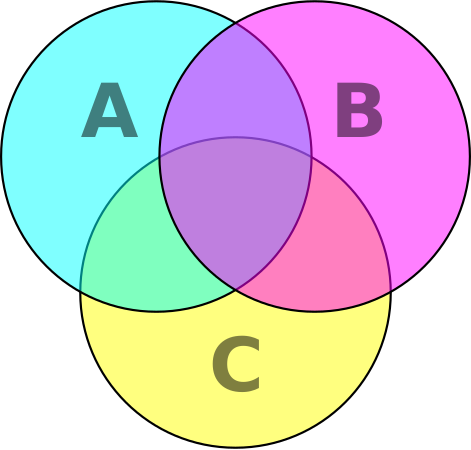
    It's not a strange multiple personality disorder that we're all afflicted with - it's simple human nature. We can think of our society as a complex multi-dimensional venn diagram, where each person's perception of their identity is represented by a single circular region, and intersections between these regions represent groups.  We see this all the time in our personal relationships - there are obvious differences between how our partner, family, friends and colleagues understand us, and what information we are prepared to offer them. We maintain all of these relationships - we keep information from some people while providing it to others, and people sometimes make stuff up. It's not some nefarious deceit - it's just a fundamental part of the way humans manage relationships.

    We see regular evidence of this human behaviour online. We attempt to keep professional and social associations separate on Linked-in and Facebook. We experience discomfort when 'friended' on Facebook by people we don't consider friends. Obviously the boundaries vary greatly for each person and within each group, but that's part of the point - everybody is different, everybody creates boundaries where they are comfortable, and not everybody is a friend. The push to make us all singularly open creates weird fantasy lands - just what you would expect in the real world if we were only able to expose a single identity - the minimum intersection that is comfortable in every context.

    An unfortunate aspect of this is that our uniqueness, our creativity, our gravitas even, is often best represented by the parts of us that intersect the least. This is regularly the best expression of who we really are, what drives us, and what makes us unique individuals. We have many real world identities - subsets, intersections and mutual exclusions - all of them constantly moving. It seems utterly counter-intuitive to me that we should be engineering our online world to bring all the regional intersections of our social venn diagram into alignment. Unless we are trying to model something different to real-world identity, then we're doing it wrong.

    Tim O'Reilly noted that 'It's not a matter of perfect intelligence and perfect stupidity, its a matter of a mixture of intelligence and stupidity, of brilliance and idiocy all in the same brain, of failures of will, failures of virtue, failures of goodness, at the same time as enormous heroism, enormous accomplishment - all these things are going to be true of internet applications, just as it is true of individuals'.  We need to embrace our humanity, and recognise that the quest for our one true, homogenous and palatable internet identity is just an insidious endeavour in global groupthink.

    Multiple identities online give us new opportunities for self expression as well - providing the capability to publicly explore elements of our psyche that we would otherwise keep private. Some of that will be roughly hewn rubbish, it's true, but the key here is that the internet provides new opportunities to be comfortable with being wrong. If we are anonymous, we need not fear rejection. This is important, because the idea of 'fail fast' is one that we know to reap rewards. Allowing multiple identities gives us new opportunities to fail fast as individuals, and, on rare occasions, to succeed fast. Either way it's a win-win situation. It's not just the identity owner who benefits - if we enable more fail-fast behaviour, for individuals and groups, then society as a whole benefits enormously.

    How can we engineer support for multiple identities?

    Whether or not you agree with the argument for multiple identities, a mechanism for achieving it is reasonably obvious. If we see the internet operating system emerging, then we should need to log in once with an identity provider, and have the opportunity to switch profiles at will. Each application in the operating system sees a profile as an identity, and only the identity provider maintains the information that associates profiles. It's up to me whether I want one or many profiles. It's my responsibility to take as little or as much care as I like to keep these worlds logically separate from each other. I get to define how much information about my true identity is revealed in a particular profile. If I only want one profile, then usage would be identical to our current experience. It's fairly simple, and it's a better match for the reality of how we manage identity in the real world.

    It's understandable that we don't have this today1 - but we shouldn't kid ourselves that what we do have is a good representation of how we manage identity in the real world. Sometimes we seem to be working on the assumption that human nature should be changed rather than modelled [Mark Zuckerberg][Eric Schmidt]. Looking at the Apple Human Interface Guidelines for some perspective on this is quite helpful -
    To help you discover the mental models people associate with your product’s tasks, look at how they perform similar tasks without a computer... Design your product to reflect these things, but don’t insist on replicating each step a user might take when performing the task without a computer. Take advantage of the inherent strengths of the computing environment to make the whole process easier or more streamlined.
    Obvious stuff, and it not only highlights that we should be modelling the way people do things in the real world, but that we should be seeking improved facilitation of this behaviour.

    Additional considerations with this approach

    It might be argued that people maintaining multiple identities is a hassle for the authorities. However like most things, regulation and control is a better solution for something that people will undertake regardless of the authorities' position. A key element of the above solution is that an identity provider maintains the relationship between profiles, and can correlate this to a single login. A profile can be provided to an application with data that only the identity provider can use to perform this correlation. It's easier to regulate and control. I'm not suggesting people would cease to create multiple logins, but we would observe some separation between those who manage multiple identities for reasons of self expression, and those who do so for nefarious purposes. Of course there are many legitimate reasons why someone might not want any linking information to be stored, and I'll explore that scenario below when looking at 'true anonymity'.

    The risk of unauthorised access at the identity provider is real, as is hacker activity. These represent the greatest risk to identity management in general, but especially maintenance of separate identities. It seems clear to me, however, that as identity provision becomes standardised, and its importance better understood, the need for security and enforcement against such breaches will become more obvious and more regulated. The role of identity provider will increasingly become one which carries significant responsibility and users will choose an identity provider on the basis of how they perceive the security they offer. As we enter the world of public participation in government, many aspects of identity management will become increasingly necessary - the need for regulation, trust, verifiability and credibility will all see an increase in importance.

    Credibility

    Credibility is something that we know is necessary for online activities that require trust. No one likes a zero star seller. With the identity management solution outlined above, we get new opportunities for managing credibility - especially if this is something maintained by the identity provider. For example, e-bay could specify that their reputation is transferable between user identities - so that no matter which profile we enter e-bay with, we retain a common reputation score. Conversely, a forum might specify that reputation is not transferrable. This leads to yet another interesting possibility - the capacity to merge profiles. If you have been posting on a forum with multiple profiles, you might choose to combine them, and with such a merger deliver increased (or decreased) reputation to the new identity.

    One of the arguments against multiple identities is that it generates a lot of noise - people being antagonistic, offensive or just spouting rubbish with no requirement to own up to these contributions. Using a credibility mechanism provides an excellent tool for managing this problem. A profile with low credibility (such as one that is newly created, or often marked down) can be easily distinguished from one with high credibility. It would generally be in the user's interest to improve the credibility of the profiles that they use. Credibility metrics are a critical example of how we can achieve additional benefits in online identity management.

    Verifiability is a part of credibility, but it has some interesting additional aspects. An identity provider could offer the means for you to verify that you are you. If you provided your passport or driver's licence, then the identity provider could indicate this increased confidence in each of your profiles by increasing your credibility. In something like participation in government - the fact that you have this kind of credibility could be a requirement for participation in some forums. Something similar could be achieved for qualifications. This mechanism would also provide significant protection against online identity theft. I'm not proposing that this should be a requirement for having an online identity, but would represent a legitimate option for improving credibility.

    Plenty of other credibility management opportunities exist, particularly around endorsement by others - but the basic argument is that delivery of a mechanism for managing credibility - one that can span the entire user or individual profiles and apply both in individual applications and universally - is a basic and necessary part of participation on the web.

    What about Gov 2.0?

    Gadi Ben-Yahuda provided some good analysis of the role of anonymity in Gov 2.0, observing that there are pro's and con's. He concluded that we do need to reveal our true identity to contribute to online government, and constructed a useful scale of escalating disclosure on the basis that the more influence you have, the less private you should be. He concluded that participation in Gov 2.0 required scrutiny a little greater than we would expect when speaking at a town-hall. However, it's a one-size-fits-all observation - Gov 2.0 should enable us to participate at all the levels he identified and more in between. With the ability to maintain multiple online identities, we can achieve this relatively easily, providing the user with the means to reveal only what is required by the particular forum. This is a great application of the human interface guidelines - we can deliver a better outcome by taking advantage of the strengths of the computer environment.

    His main argument in support of anonymity is that it allows the speaker to be completely truthful - they don't need to fear personal repercussions for saying what they really think. It's important to observe that this is the primary reason why we vote anonymously. Not only that, but it's considered rude to expect someone to tell you how they voted. It's a critical example of the need for anonymity in real world government processes.

    True Anonymity

    The Electronic Frontier Foundation makes a number of good points on the role of anonymity, especially in relation to government and politics. The statement highlights the fact that we need secure anonymity. They argue that you will only say what you think if you feel confident that your anonymity can be preserved. Clearly if an identity provider maintains the relationship between your profiles, and provides trackable information to an application (even though the application itself cannot use it), then there is no such guarantee.

    For true anonymity to work, the identity provider must deliver an anonymous profile to the application - one that does not contain information to link back to the user id at the identity provider. You might maintain many anonymous profiles, and provide as much or as little information as you liked - your credibility, your country of residence, even your postcode - the key is that the application isn't given the specific identifying information needed to trace back to your account at the identity provider. Obviously if you gave up too much information in your anonymous profile, then deduction might be sufficient to identify you - but that is a risk for the user to manage. Also, there would be no way for credibility to be affected by contributions made anonymously, but providing your base credibility with the anonymous profile might be considered useful in some contexts. It is important to recognise that we can achieve 'true anonymity' while still providing information that is trustable, and might be required in a particular forum.

    Another consideration is that delivering true anonymity would need to be reconciled with the authorities' desire to track internet usage against real identities - a battle which the EFF and governments are fighting on a daily basis. It's not necessary to open this can of worms here - just to observe that there is no technical reason why true anonymity cannot be supported. Even more importantly, if we want to realise all the benefits that Gov 2.0 can offer, then we need to support it.

    Conclusions

    Andrea di Maio said we need to balance the desire of government to get closer to citizens while respecting their desire and right to privacy. It's worth highlighting that the converse is also true - we need to balance the desire of citizens to get closer to government while respecting their desire and right to privacy. Citizens shouldn't be required to reveal more than is necessary - precisely because the most important thing is knowing what people really think. Effectively managing multiple identities and anonymity is a major facilitator in lowering the barriers to participation in government.

    We are correct to strive for a one-to-one relationship between our physical self and our internet login, but mistaken to extend that to the relationship between our login and our online presence. I've offered a rough outline for a solution, and looked at some of the opportunities and risks. It's true that our current software infrastructure would struggle to realise this vision, but it's a simple argument - if people are creating multiple identities online and will continue to do so, and if the benefits are clear, then why aren't we modelling this behaviour properly with online identity? The social web must enable us, not constrain us.


    UPDATE 18/01/10: It seems I missed the Open Identity For Government initiative while researching this post. I'm not sure how I managed that, but there it is. The initiative is high profile, wide ranging, and highly relevant to this discussion. It's based around OpenID & Information Cards, and provides many of the technical elements of my suggested solution - specifically: true anonymity with verifiability, pseudonyms, limiting personal information depending on the forum, centralised management at a trusted identity provider and strong regulation at the identity provider. The system also offers the ability to maintain multiple identities, although aspects such as identity merging & portable credibility do not seem to be supported. The initiative is, however, a great basis on which to build these elements, as it represents an ideal subset of my proposal. From another perspective this post represents an independent thought stream that reached the same conclusions, and provides plenty of meat for going beyond their proposal. In any case, apologies for the research gap - at least I found it before someone pointed it out to me :) I'm really excited by the direction that the Open Identity Initiative is taking. It looks like we're doing it right after all!

    1. There is some recognition of this concept in OpenID, with a 'personas' feature allowing you to maintain different sets of information with a single OpenID. It's heading in the right direction, but it's an optional registration extension, and only implemented by a few identity providers (e.g. myOpenID). It is only utilised when registering with a service provider (application), and certainly not something the service provider needs to be aware of.  The OpenID specification itself has very few references to the concept - simply describing the feature as
    'A subset of the user's identity data. A user can have multiple personas as part of their identity. For example, a user might have a work persona and a home persona.'
    It's ineffective for maintaining multiple identities in the manner I have described for a number of reasons, but primarily because each persona is a subset of the same data set, and secondly because there is no mechanism or requirement for the service provider to recognise separate personas. One reason for this is that it would be considered too big a job to add this support to all of the applications on the internet. However I think if you saw a few major providers - Google, Facebook etc. - doing so, smaller players would begin to support it as well. Another reason might be the added complexity to users - 'I know about username and password - what's this new persona thing'? However it would be simple to hide the persona features using a default persona, and making that the standard behaviour - the usage flow would remain unchanged for those that don't use the feature. A user need not even be aware the feature exists.

    Saturday, January 2, 2010

    Political Entropy

    Entropy is a strange word. If we look at some definitions, the strangeness becomes apparent through a list of synonyms: chaos, uncertainty, equilibrium, stasis, homogeneity. I'm going to use it to show that public participation in the policy process is inevitable. Unavoidable. A sure thing.  We need to get ready for it.

    In thermodynamics, where it all started, entropy is a measure of the uniformity of energy distribution within a system - higher entropy means more uniform distribution. John von Neumann is reckoned to have told Claude Shannon to name his measure of uncertainty in information theory 'entropy' because (among other things) 'nobody really knows what entropy is, so in a debate you will always have the advantage'.

    Wikipedia offers:
    'An everyday example of entropy can be seen in mixing salt and pepper in a bag. Separate clusters of salt and pepper will tend to progress to a mixture if the bag is shaken. Furthermore, this process is thermodynamically irreversible. The separation of the mixture into separate salt and pepper clusters via the random process of shaking is statistically improbable and practically impossible because the mixture has higher entropy.'  - Wikipedia
    This highlights another key part to our understanding of entropy - a closed system will increase in entropy both inevitably and irreversibly. We can see this in cosmological entropy, which argues that our universe is a closed system, and will thus reach a state of maximum entropy where all energy is evenly distributed and (consequently) all parts of the universe will be the same temperature.  It's a theory that doesn't bode well for us in the (very) long run.

    For me, when I hear the word entropy, I don't perceive a unit of measure - I perceive the irrevocable march toward homogeneity. Keeping heterogeneous things that are in contact from becoming homogenous takes a lot of effort. We see global systems become more alike as they come into contact, loss of biodiversity, loss of cultural diversity, loss of political diversity, loss of economic diversity, and loss of the protections that come with diversity. There's not much to be done about it either - as we go global, as our culture becomes a single closed system, rising entropy is inevitable. We see our attempts to keep our heterogeneity alive taking a lot of energy, and generally failing.

    In light of this, we might observe three options:
    1. Get some negative entropy - find some new cultures
    2. Start embracing entropy - hooray for homogenisation!
    3. Create closed systems - don't put salt and pepper in the same bag
    Point 1 only delays the inevitable. It is highly interesting that elements of both point 2 and point 3 are generally championed as solutions to the problems we face today. Is retaining some heterogeneity while allowing some homogenisation the right approach? Can it be possible to maintain both heterogenous and homogenous elements in a closed system? What is the right combination and how do we control it? According to the laws of entropy, it would appear that we can neither stop nor reverse homogenisation. Of course seeing our world as a closed system is short sighted: it is part of our solar system, which is itself part of our galaxy, and our universe. We get energy exogenously from the sun, and all life ultimately uses this source of energy to endogenously maintain diversity - to swim against the relentless tide of rising entropy. From this perspective we apparently have great potential to choose between homogeneity and heterogeneity. The trap, however, is that whenever our attention wavers, the tide sweeps us a little further toward homogeneity, and the way back may never appear. We must fight perpetually for heterogeneity if we want it. Once we perceive diversity, it is at permanent risk of fading away.

    The term 'political entropy' is interesting:
    “The entropy measurement gives the average social uncertainty about what will happen for event sets in the social system. An entropy value for a unitary social system is analogous to a temperature reading for thermodynamic system, such as a volume of gas . In a state of temperature equilibrium one temperature measurement describes the whole volume of any part of it. If a social system is in an entropy equilibrium, a single entropy measurement describes the state of the system or any subsystem. For a system in partial equilibrium, the entropy values of its subsystems must be known.“ - Stephen Coleman
    Coleman is saying that when we reach maximum political entropy, we will have maximum uncertainty over what is happening - in a democratic system this might mean many candidates with similar popular support - calling the result is very difficult.  Further research supports this interpretation: Coleman felt that the lowest entropy system was one where the certainty of the political outcome approached 100% - e.g. a one party democracy.  He also understood voting patterns as a means to measure political entropy - at minimum entropy any vote sample will identify the outcome, while at maximum entropy we must sample the entire vote to reach a conclusion.

    One key aspect of the thermodynamic system is the inevitable tendency toward homogeneity, and Coleman identifies this is in his discussion of political entropy - we will head towards political systems with less certain outcomes. Also highlighted is the role of heterogeneity - the presence of subsystems, each of which must also be undergoing changes in entropy, and which influence each other to reach an eventual state of entropy equilibrium.  This subsystem relationship must also be recursive, with subsystems containing subsystems to an undefined degree of complexity.  The conclusion here, then, is that at maximum entropy a democratic political system is homogeneous - every citizen is a candidate with the explicit support of themselves alone.

    Of course, we don't have the mechanics to support such a homogenous system - it is not possible for political entropy to reach that equilibrium.  It doesn't make sense at many levels - what are the means of election? what are the means of governing?  In fact, a maximum entropy democracy sounds a lot like anarchy. That's ok though - it's a theoretical maximum, an ideal - it serves as a bookend in the entropy discussion. We can observe, however, that public participation in policy making provides a pressure to increase political entropy - more people, more involved, more often. And therein lies a small paradox - our quest for transparency, for involvement, to have a say in our own government will actually deliver less certainty.

    Less certainty? We don't want that do we? One might assume such at first glance, but if we look at some recent history of certainty [Iraq War][Copenhagen][Business deals][Credit Crunch][Iran election] we may see that it is in fact our our ignorance and impotence that drives calls for a more participatory and open government.

    So now, with a little imagination, we can begin to see our political and cultural landscape through the lens of thermodynamics - as bubbles of gas inside each other, determined to coalesce into a single bubble of uniform temperature. On this landscape, humanity helps, hinders, increases, reduces and divides these bubbles - often unintentionally, and often without understanding the outcomes and implications.

    When we look at the future of government, something becomes clear in the context of this discussion - it is inevitable that citizen involvement will increase and, barring monumental upheaval, we can't stop it, and we can't go back.  We're going to need better tools to manage our cultural and political entropy - because government as a platform will deliver mechanisms that allow us to move ever closer to the theoretical maximum.

    Sunday, December 27, 2009

    Measuring Opportunity

    In a recent post, I discussed 'compulsory voting' as a powerful tool for measuring opportunity. It is important to note that 'compulsory voting' only mandates that you demonstrate your opportunity to vote, and does not compel you to vote.

    Some theorists suggest that democracy is not something that everyone should participate in :
    "The effective operation of a democratic political system usually requires some measure of apathy and noninvolvement on the part of some individuals and groups." - Samuel P. Huntington
    There is a perception [Noam Chomsky][Andrew Gelman] that Huntington was proposing a ruling elite - a minority rule in which (as Chomsky puts it) '... the peasants cease their clamor'. From such a perspective it is hard to extract the idea that Huntington saw that everyone should be given the opportunity to participate. The observation on its own, however, could appear to be a pragmatic expression of the statement - 'One should not be compelled to participate, but one should have the opportunity to participate'. To my mind, the latter holds more importance than the former, and thus we arrive at a middle ground ('compulsory voting'), where your participation is required only to the degree that your opportunity is reliably measurable. Alternate mechanisms of measuring opportunity may reduce this burden of compulsory participation.

    To this point we have been talking about representative, liberal democracy - where an elected minority have the power to implement policy, under the assumption that they will do so in accordance with the policy platform on which they ran to obtain the mandate of the people. This mechanism is a solution to the scalability problems of direct democracy - i.e. not everyone can have a say on all things all of the time.

    Samuel Huntington might observe the solution to another perceived problem - not everyone should have a say on all things all of the time. He might argue that this is a positive side effect of our solution to the scalability problem. There are many reasons why we might want to solve the second problem - some decisions need to be made quickly, some decisions need to be made with expert advice, and some decisions have subtle implications that are not easily perceived without a detailed awareness of the problem.

    Largely, in modern democracy, the people do not make policy decisions, for both scalability and pragmatic reasons. For example, an Australian citizen gets two opportunities to do so - voting in elections (Federal, State and Local), and voting in referendums. The opportunity to participate directly in policy decisions beyond this is very difficult to perceive [media][lobbying][big business][nepotism][etc.] - and the transparency of those policy decisions is very often questionable.

    It is in this space that Gov 2.0 provides new opportunities for our democracy - public participation in policy. It increases our opportunity to participate at a fine grained level in a far wider range of policy decisions.  It offers us new opportunities to solve the scaling problem.

    Of course we also have the problem of pragmatism - who should be eligible to participate? Eligibility to vote is generally determined by citizenship, age and residential address. Becoming eligible to participate in policy at a finer level may not be so trivial - a formal qualification or previous experience might be required. Expert labs offers some insight in to this aspect of policy making. To reliably extend this participatory model to everyone, we must be able to measure the opportunity to obtain the necessary qualifications or experience. And here we see a key element of 'opportunity to participate' - measuring opportunity is hard, even when the rules are very simple, such as for voting. Measuring opportunity when the eligibility criteria are more complex will be even harder.

    Almost by stealth, we have begun to discuss two elements of opportunity -
    1. Opportunity to become eligible to participate - women were denied this opportunity until recently
    2. Opportunity to participate once you are eligible - afghani citizens were denied this opportunity under threat of violence
    One might observe that these are essentially the two elements of suffrage. However, suffrage applies only to the right and opportunity to vote, and not to more complex processes such as policy making.  Point 2 is largely unchanged in both situations, however point 1 takes on a different meaning - eligibility might be earned, rather than an inviolable right, and we must now measure a group or individual's opportunity to become eligible - we can no longer wave the wand of universal suffrage to satisfy eligibility.

    Of course policy making doesn't happen once every four years - it happens in real time, all the time - which is why Web 2.0 is such a great fit. Surely we can't show that everybody had all their opportunity, all the time - in fact we can largely guarantee that they didn't. With government as a platform - a system available on the internet, in the cloud - we have the potential for a new means of 'turning up', of proving your opportunity: log in periodically. This mechanism is a little strange - and highlights vividly the difference between turning up to the polling station on the one hand, and submitting your vote on the other - the former demonstrates that opportunity, while the latter exercises that opportunity. It is a convenient coincidence that they are one-to-one. By logging in to the government platform you could demonstrate your opportunity to do many things - everything the platform offers - a one-to-many scenario.

    This also highlights the converse situation - the reason why people are opposed to 'compulsory voting'. Requiring every citizen to log on to a government system periodically is an extreme version of turning up to the polling station - and feels much more restrictive - or does it? If, instead of turning up to the polling station on a designated day for each compulsory election, you could go to your local library, or sit at your desk at home - wouldn't that be easier?

    There are a great many additional considerations, especially related to identity [Andy Oram][Gadi Ben-Yahuda], but one of the things we will need to consider is the opportunity to participate in Government as a Platform, and how we measure that opportunity - especially when the requirements for participation are more complex than how old you are and where you live.

    Wednesday, December 23, 2009

    'Compulsory Voting'

    This is a topic that I often have long discussions over.  From my perspective the arguments for 'compulsory voting' are many, and those against are few, and weak.  As an Australian citizen, I'm familiar with a 'compulsory voting' system, where eligible citizens are fined for failing to show up at the polling station.

    Why the quotes around 'compulsory voting'?  Well, because its not voting that is compulsory, but registering that you had the opportunity to vote.  It is perfectly legal to turn up to the polling station, have your name crossed off, and deposit an unmarked ballot paper. 'Compulsory voting' suffers badly from a poor name that not only fails to convey what it represents, but also conveys something that it does not represent.

    Arguments for 'compulsory voting':
    1. Demonstrating opportunity to vote - a democratic system where some eligible citizens are denied the opportunity to vote is not functioning correctly. In a voluntary voting system, how do you tell the difference between someone who chose not to vote and someone who was unable to vote? We see examples in US elections of some voter segments being unable to vote due to lack of electoral resources, or worse, strategic removal of resources to commit fraud. Whether this is fact or fiction is beside the point - we can't tell the difference between those who did not get the opportunity to vote, and those who got the opportunity, but chose not to exercise it. Assuming you are correctly registered, a 'compulsory voting' system will ask you to explain why you didn't attend a polling station, and fine you if you cannot do so.
    2. Undermining intimidation - it may be the case that opportunity to vote exists, however third parties place an eligible citizen under pressure not to vote.  We see this in Afghanistan where the Taliban threaten physical harm to those who vote.  It is also the case that some elements of society are put under pressure not to vote for religious or cultural reasons.  While 'compulsory voting' will never remove intimidation, it provides a powerful weapon against its effectiveness.
    3. Accurate Representation - Society places huge demands on our time, and for some people, those demands are much greater than for others. It seems incredibly idealistic to assume that in a voluntary election the people who vote are those who wanted to, and the people who don't vote are those who didn't want to. In a voluntary election, it seems obvious that the proportion of people who vote will be skewed towards those who find it easier. People working two jobs, single parents, handicapped and disabled, people very distant from a polling station, people with large families, with sick children (the list goes on) may find it difficult to vote. None of these groups are by definition any more 'apathetic' than any other group, but I'd put money on them being less represented. These groups often only have time for things which are compulsory. This argument essentially says that with 'compulsory voting', the less able and less well-off are more effectively represented.
    4. Separating apathy and laziness - Surely those are synonyms, right? In some contexts, perhaps, but to me, apathy means 'I don't care', while laziness means 'I can't be bothered'. I'm going to approach this discussion from personal experience. I have spent a lot of my adult life in the UK, where I am also a citizen with the right to vote, and where voting is voluntary.  I've had many political conversations, on numerous occasions with people who are well aware of the political landscape and what is going on. These discussions are often deep and heated, with a very broad range of well constructed analyses. These people are keenly interested in politics. It is extraordinary how many of them don't vote.  Since I'm talking from personal experience, I should point out that I have only voted in one UK election, despite being eligible since 1996, and living here for roughly half that time.  So, anecdotes about others aside - I have the opportunity to vote, I'm not politically apathetic, but I don't vote. What's going on? Well, I'd say a bit of point 3, a bit of laziness and a bit of point 5.  It's amazing how much you can find to do on a Saturday instead of going to the polling booths.  I wonder how many people reading this haven't voted at every opportunity, yet do not consider themselves politically apathetic?
    5. Fighting the perception that one vote doesn't make a difference - every sensible person knows that democratic elections are won by tallying all the votes and determining the winner - sometimes according to a ludicrously complex representational system - but the basic principle is there. It is plainly obvious that your vote counts (assuming no fraud - 1, 2, 3), yet you just can't fight that feeling, on election day, that it won't make a difference whether you turn up or not. The polls say 'Candidate A' by 2.5% - that's like a gazillion votes - if I don't turn up it will be a gazillion minus one. It is so easy to justify not turning up - our brains just can't cope with the logic of operating in a group of that size. We see the same psychology with conservation efforts - nobody wants the world to frizzle or choke, but drawing any relationship between switching a light off and an effect on the larger environment is just about too much for our brains to cope with. We have to work hard to apply the logic, even though we know it must be true. 
    Arguments against compulsory voting:
    1. Voting is a Civil Right, not a Civil Duty - I'm happy with that definition - you shouldn't be forced to vote. Handy, then, that 'compulsory voting' doesn't force you to vote. What is a necessity, however, is knowing that everyone who was eligible, and wanted to vote had an opportunity to do so. Right now, our best chance to achieve that is making it compulsory to demonstrate your opportunity. If we could find a solution that didn't require you to physically turn up on election day, that would be great, but for now its the best we have. 'Compulsory voting' delivers on all of the above arguments, while still offering your civil right to (or not to) vote. This argument is saying that you shouldn't have to do stuff if you don't want to. Well, you have to pay taxes, you have to drive on the correct side of the road, you have to avoid the urge to hit people. Saying 'Hey, I could have voted if I wanted to', doesn't seem much, and arguing against it seems a touch pedantic, especially looking at all the benefits.
    2. It isn't easy to deliver, or enforce - This is very true. In Australia, compulsory voting relies on the accuracy of the electoral roll - this ensures that your name is on the list when you turn up to the polling station. You also need to be able to prove who you are, and where you live. If you don't turn up you get fined - but the fine notice is sent to the address on the electoral roll. Keeping the electoral roll up to date requires constant maintenance, and something that can never be done completely. If you never enrol, then you'll never be fined for not turning up - but of course you can't vote unless you're on the roll. A lot of effort is made by the government to keep the roll up to date, and the process is fairly simple. That's in Australia - and in the global context, life ain't hard in Australia (for most people). Apart from a protracted effort to destroy the culture that first occupied Australia, the most civil unrest Australia has experienced appears to be a couple of small riots (1, 2). Implementing 'compulsory voting' in places where things aren't so stable could be a real challenge. This argument is, however, a falsehood. If we ran our society on the basis that we should only do what is easy, and not what is right, then we'd have, well, hmmm... something like what we have now. We've just seen in Copenhagen how doing hard things can be tough - even when they are right. We need to do hard things, and we shouldn't avoid them because they are hard. This argument says we shouldn't do 'compulsory voting' because it is too hard, and that's not a sufficient, especially when we begin to reap the benefits even when the implementation is not perfect.
    3. Uninformed, ignorant, or apathetic people shouldn't be deciding our government - 'people like X shouldn't be voting' - sounds pretty bad - just having a list is a recipe for real problems. I'd first say that using failure to vote as a discriminator for anything is useless. As discussed above, the people who don't vote when voting is voluntary fail to do so for many reasons, and can not be identified as fitting into any specific category other than 'those who didn't vote'. Lets look at it from another angle though - would our world be better if everything were decided by a benevolent, altruistic genius - the benevolent dictator, or enlightened despot? Perhaps all our efforts should be put into finding benevolent dictators. What would be the process for finding such a person? Would everyone get a say, or just some people? Perhaps the despot could choose their successor, or some other mechanism might be used? When looking at these options, we realise that all our political systems, in one way or another, represent a search for the enlightened despot. Our Leader. Of course most systems have worked out by now that we have to limit the powers of our enlightened despot, in case we get it wrong and he turns out to be just a despot, or even worse - a malevolent despot. In the US, the president may only serve 2 terms, and many people are currently very thankful for that limitation. So how does all this relate to the argument that some people shouldn't vote - that representation of ignorance is bad for the political process? Only that one man's ignorance is another's enlightenment - and that everyone is affected by the government that is elected - 'ignorant' or 'informed'. This argument boils down to 'I only want people to participate if they are likely to agree with me', or worse 'I know better than you do what's best for us'.  It's a false argument.
    It is important to note that there are a great many arguments against being forced to vote - 'don't like the candidates', 'can't trust the media', 'nothing ever gets done', etc.  These are not arguments against demonstrating your opportunity to vote, and therefore not arguments against 'compulsory voting'.  'Compulsory voting' does not compel you to vote.

    In the end, it all boils down to how we measure opportunity to participate.  We need to start talking about measuring opportunity, not 'compulsory voting' or voluntary voting.  Finding new, less intrusive and more powerful means to measure our capacity to participate must be a goal for an evolving democratic process.

    Thursday, December 10, 2009

    What is Gov 2.0?

    To answer this question, we must first ask 'What is Gov 1.0'?  Our initial reaction might be to talk about service provision - Health, Education, Infrastructure, Treasury, Law, Security etc.  However all these things are just side effects of the policy process -

    - Agenda Setting
    - Assessment of Alternatives
    - Policy Making
    - Policy Delivery
    - Measurement
    - Refinement

    It is these that we are influencing when we shake the vending machine - be it 1.0, 2.0 or squared, be it socialist, communist, a democracy, monarchy or autocracy. Thus, with Gov 2.0, a core goal must be to improve the quality of, and capacity for public participation at this level.  It is here that transparency and involvement  are most critical.

    With that background, how would services like this appear?

    Gadi Ben Yahuda recently wrote 'The Future of Gov 2.0: Law By Wiki?'.  It touches on a part of Gov 2.0 that seems to be missing in many discussions, and which I highlighted in a previous post - public participation in the policy process.  It's not about contacting your local member through facebook, or subscribing to their tweets - it's about having the facility to actually make direct contributions as an individual.

    Seeing a wiki as a tool for policy creation is an excellent first step, because it makes an absolutely crucial observation - policy management is knowledge management.

    Perhaps this vision of public participation in the policy process lies beyond Gov 2.0 - Gov Squared?  Andrea DiMaio listed four facets of Web 2.0 in government and certainly explicit means for public participation in the policy process are absent.  Perhaps it is implicit - deliver these facets, and we achieve improved public participation in the policy process.  To me though, it's the Web 2.0 version of the government we already have, and true involvement in the actual policy process is only fractionally closer.  We remain firmly rooted in representative government as our only means - something largely driven by past technical constraints on a scalability problem - a problem that is dissolving before our eyes.
    'It has been said that democracy is the worst form of government except all the others that have been tried' - Winston Churchill
    On the horizon is a world where we can form ad-hoc representative structures, even choosing to represent ourselves.
    'If liberty and equality, as is thought by some, are chiefly to be found in democracy, they will be best attained when all persons alike share in the government to the utmost.' - Aristotle
    Perhaps it is time not only for technological advancement, but to consider the emerging potential for evolution of democracy itself.

    Building a Better Vending Machine

    While positing the question 'What does Gov 2.0 mean to you?', Tim O'Reilly asks
    'How do we get beyond the idea that participation means "public input" (shaking the vending machine to get more or better services out of it), and over to the idea that it means government building frameworks that enable people to build new services of their own?'
    He's pointing toward Government as a platform.  We are always going to be shaking the vending machine - it's the citizen:government relationship.  To my mind, 'Government as a platform' is about building a vending machine that provides greater diversity in the ways it can be shaken, and responds more effectively when it is shaken - adding capabilities organically so that we don't always need to shake it to get what we want.  In a world of seemingly infinite collaborative possibilities, we need to take public input to the next level - to create a government that is inherently participative, transparent and responsive.

    Here's an interesting conundrum - What proportion of our government can be delivered through 'Government as a platform'?  Are there services for which it is not suited?  If 'Government as a platform' is a government service, can this service be delivered through the platform?  Can we build a platform that enables the delivery and maintenance of all government services, including the platform itself?  Now that would be a pretty cool vending machine - where citizen and government are one, and shaking the machine means shaking ourselves.

    Friday, November 20, 2009

    Public Participation in Policy - PPP

    For this year's Web 2.0 Summit, Tim O'Reilly and John Battelle produced a white paper defining 'Web Squared' - their next evolutionary step beyond Web 2.0. It's about the opportunities for harnessing our collective intelligence. Data in context, in real-time. It's about seeing the web as a conduit for making real things happen in the real world, in ways that couldn't possibly occur without it.

    This is the first example of web squared from the above white paper:
    'The election of Barack Obama has demonstrated how the Internet can be used to transform politics. Now, his administration is committed to exploring how it might be used to transform the actual practice of governing.
    The US Federal government has made a major commitment to transparency and open data. Data.gov now hosts more than 100,000 data feeds from US government sources, and the White House blog is considering a commitment to the 8 Open Data Principles articulated by a group of open data activists in late 2007. There’s a celebration of the successes that many are now calling "Government 2.0." We’d love to hear about Government 2.0 success stories from around the world.
    But in his advice on the direction of the Government 2.0 Summit Federal CTO Aneesh Chopra has urged us not to focus on the successes of Web 2.0 in government, but rather on the unsolved problems. How can the technology community help with such problems as tracking the progress of the economic stimulus package in creating new jobs? How can it speed our progress towards energy independence and a reduction in CO2 emissions? How can it help us remake our education system to produce a more competitive workforce? How can it help us reduce the ballooning costs of healthcare?'

    There are a number of points to take from this -
    1. The provision of data in context, with semantic meaning, is the main achievement to date e.g. data.gov . This delivers transparency on what's already happened, and to a lesser degree on what's happening.
    2. We are now looking at how we can go further than simple data provision, to solve problems - to act on this information. Not only transparency, but application.
    3. We are looking at application in terms of achieving actual policy outcomes.
    4. If you read between the lines - we need to create the means to crowdsource involvement in the  policy process - discussion, definition, implementation, communication, review and measurement. Transparency not only on what's happening, but on how and why things happen.
    Provision of government data and services is really just the tip of an iceberg - the real value will come when we can provide the capacity for transparency of, and participation in the entire policy process. The complexity of the policy process is immense - it makes sense to start with data and services, but the vision for Gov 2.0 will inevitably be PPP. There is no doubt that Tim O'Reilly is heading in the right direction when he talks about government as a platform.

    It is no surprise that we currently use a representational system to manage our democracy - fine grained public participation in the policy process is a deeply complex vision.  It is a whole new paradigm for our democracy - the ultimate crowdsourcing endeavour, and one that is only now becoming feasible as we enter the world of 'Web Squared'.